article · August 15, 2026 · 13 min read
Prompt, harness, context, loop, graph: the jargon is a changelog
Every few months AI grows a new x-engineering word. They are not marketing. Each one marks the exact spot where the layer below it leaked, and where control moved one step further out of the model.

Prompt, harness, context, loop, graph: the jargon is a changelog
Prompt engineering. Harness engineering. Context engineering. Loop engineering. Graph engineering. Five techniques in about three years, all for getting more out of the same box.
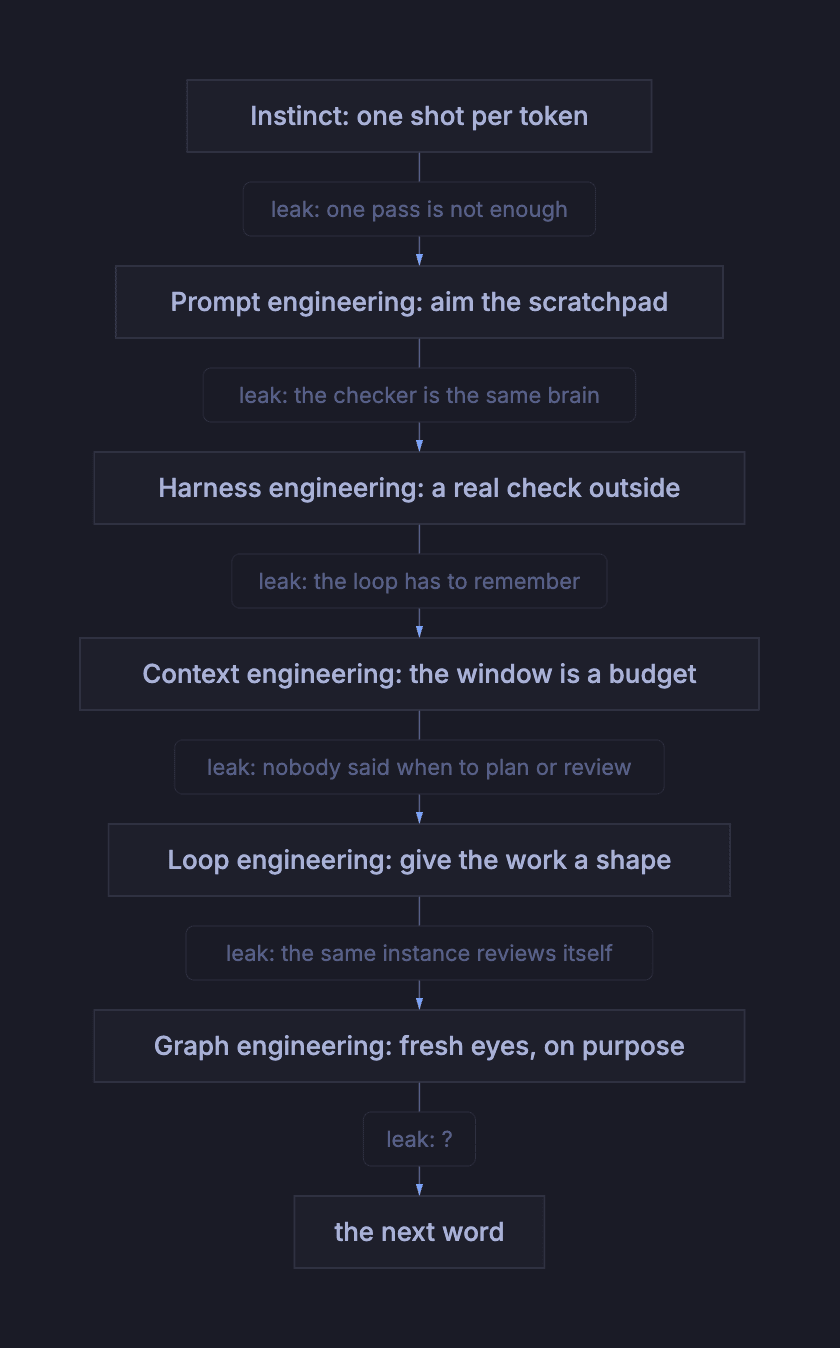
The usual reaction is that this is hype inventing vocabulary faster than it invents substance. I think it is the opposite. Each of those words marks the exact spot where the layer below it started leaking. Read them in order and you are not reading a marketing deck, you are reading a changelog of everything we found broken.
There is one line running through all five. Every new term moves control one step further out of the model.
Layer zero: it only has instincts
All five techniques rest on one fact about the base layer: it predicts the next token, and that is the whole of it. Not a lookup, not a procedure.
If you want that argued properly, Steven Chen’s How AI actually thinks is the best version I have read, and I am not going to re-run it here. Go and read it. I want one detail out of the research it sent me to, because it is the thing that changed how I build.
Anthropic
traced Claude 3.5 Haiku doing addition
and found the ones digit handled by a feature that means “something ending in 6
plus something ending in 9 ends in 5”. That same feature fires on academic
citations, where a journal’s volume number ends in 6 and its founding year ends
in 9, so the publication year has to end in 5. Suppress it and the citation
prediction moves. Swap it for _9 + _9 and 1995 becomes 1998.
Read that again. It is not an arithmetic module getting called. It is a path that runs through arithmetic on its way somewhere else, and something completely unrelated to arithmetic can walk down it. There is no procedure in there to hold onto. It is terrain.
Terrain has two properties that set up everything after. Instinct gets one shot per token. And the weights are frozen while you work, so nothing figured out in one session is there in the next.
Which fixes the job permanently, for me and for anyone building on this: get the right information in front of it before it guesses, so the guess lands on a good path instead of a popular one.
The five techniques are five answers to that one question.
Prompt engineering: aim the scratchpad
The first fix for one-shot instinct was letting the model write before it answers. A scratchpad is working memory, and it is also compute, because every token written is one more pass through the machine. Merrill and Sabharwal put a floor under that intuition: intermediate generation genuinely extends what a transformer can compute. Their actual result is more interesting than the slogan, though. The amount is what matters. A logarithmic number of steps barely lifts the ceiling; a linear number buys a real new class of problems; a polynomial number lands you at exactly the polynomial-time-solvable ones. Not whether it writes. How much.
But a scratchpad is a blank page, and blank pages get filled with whatever is most familiar. Prompt engineering was us learning to aim it. “Think step by step.” “You are a senior security reviewer.” The personas felt silly and worked anyway, for an unglamorous reason: naming a role pulls the prediction onto the paths where that role’s writing lives. You are not motivating anyone. You are picking a neighbourhood in the training data.
Then the model learned to check its own work. DeepSeek’s R1-Zero is the cleanest demonstration I know of: they skipped the supervised fine-tuning stage entirely, gave it no human reasoning traces to imitate, and paid reward only on whether the final answer was right, nothing about how it got there. Nobody wrote a rule about doubting yourself. It appeared anyway. The paper marks the moment by a sudden spike in the word “wait”, alongside responses that kept getting longer from nothing but the training itself. AIME accuracy went from 15.6% on the base model to 77.9% on R1-Zero (and 79.8% on R1).
Huge result. Also the end of the road for this layer, because the thing doing the checking is the thing that made the mistake, running on the same worn paths that produced it. An error shaped like a correct answer gets waved through, because it looks right to precisely the instinct that generated it.
The leak: everything so far, self-doubt included, is instinct. There is no guarantee anywhere in it.
Harness engineering: put the loop outside
A guarantee has to come from something that cannot be talked round. A compiler accepts the file or rejects it, and it does not care how confident the model sounded. That is narrower than it first looks: a passing test proves the test passed, nothing more. Narrow and real still beats broad and statistical.
So we wrapped the model in a program that runs it in a loop, hands it tools, reads the results, and feeds them back. That program is the harness, and it is the reason the same model performs differently in different products. Claude Code and a chat window are the same weights with wildly different harnesses.
This is the first term where the engineering is not about words at all. It is ordinary software: tool schemas, retries, permissions, what happens on failure.
The leak: a loop needs to remember. Turn twenty needs turn three, and the window is finite.
Context engineering: the window is a budget
So the harness takes over memory. What gets loaded, what gets summarised, what gets dropped, what gets fetched only when needed. Karpathy’s definition is the one everyone quotes, describing context engineering as the delicate art of filling the context window with just the right information for the next step. Anthropic’s write-up puts the sharp point on it: context is a finite resource with diminishing returns.
That reframing is the whole discipline. Not “write a better prompt” but “spend a budget.” Dumping everything in is not thoroughness, it is noise, and noise moves the prediction onto worse paths. Once you see the window as a budget, every memory file, every retrieval call, every compaction step, every dynamically loaded tool schema, and every cached prefix is a line item you can argue about.
The leak: the harness now has good memory and good tools, and still nothing tells it when to plan, act and review.
Loop engineering: give the work a shape
Plan, act, review, repeat. Nobody invented that for AI. It is how every half-decent team already works. What changed is that it became a thing you write down and enforce rather than hope for.
Concretely: a plan the agent has to produce before touching anything, gates it has to pass to move on, a fixed number of retries before it stops and asks a human. Anthropic’s building effective agents draws the useful line here. A workflow is code deciding the steps, an agent is the model deciding them. Loop engineering is setting that dial per step, and mostly discovering you wanted code in more places than you expected.
The leak: every step of that loop runs in the same instance, on the same context, with the same cache. The reviewer already read the plan. It is not reviewing, it is agreeing with itself in a different font.
Graph engineering: fresh eyes, on purpose
The fix is embarrassingly simple once you have been bitten: hand the review to somebody who was not in the room.
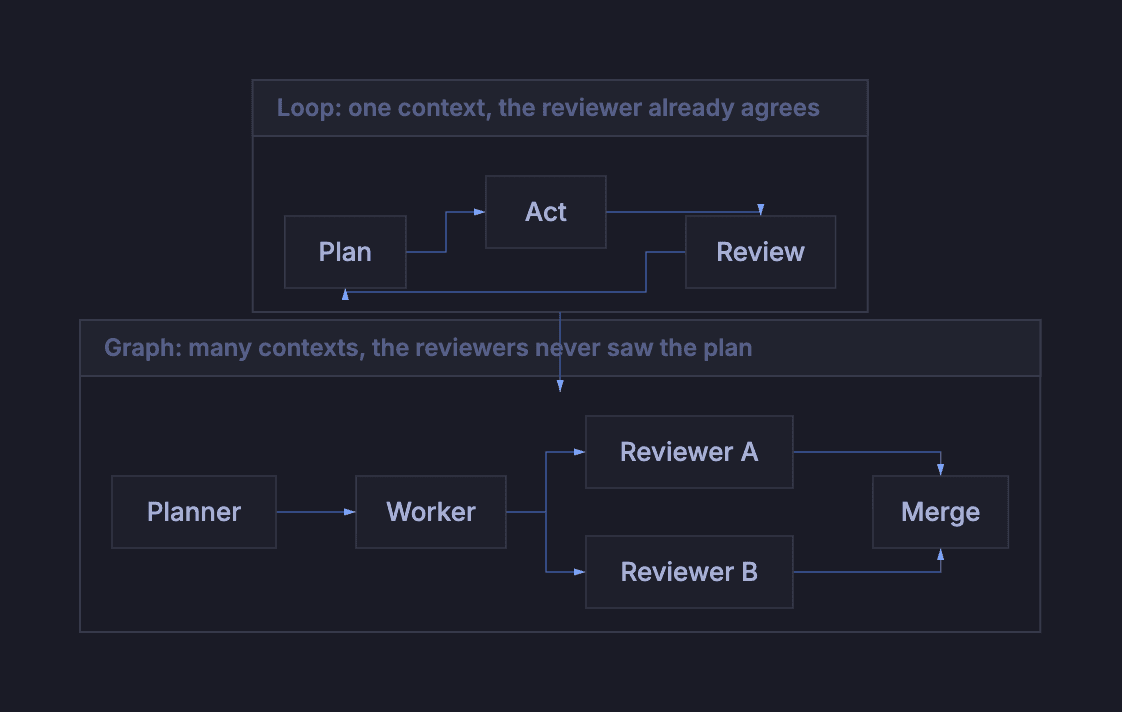
A fresh instance with a clean context and a narrow brief catches what the author-instance structurally cannot, because it never built the attachment. Then the same logic spreads through the rest of the loop. A researcher, a writer, a critic, three of them in parallel with different lenses, and you are no longer running a loop. You are running a topology. Who does what, what each one sees, where the results merge. That is the graph.
Anthropic reported a lead-plus-subagents setup beating single-agent Claude Opus 4 by 90.2% on their internal research eval, and were honest about the bill: multi-agent runs used roughly 15× the tokens of a chat, and most coding work has fewer genuinely parallel parts than research does. Fresh eyes are not free, and they are not always the answer.
Of the five, this is the term I would bet is least settled. “Graph” today covers DAG frameworks, subagent fan-out, and orchestrator-worker patterns that are not really graphs. The idea underneath it is stable, though: isolated context is a feature, not an inefficiency.
I built this before I had the words
My content generation harness has all five in it, and I named none of them at the time.
It runs on Claude Code, so the harness layer is borrowed. On top of it: audio is generated first, and its word-level timestamps become the source of truth every later stage reads. That is context engineering. I just called it “not letting the animation lie about the narration.” Almost every stage ends in a scored gate and nothing advances until it passes, three failures and it stops and asks me. Loop engineering. Script review runs six personas in parallel, each a separate agent with its own brief: a beginner, a senior engineer, an editor, a tech reviewer, a retention analyst, a competitor. The average has to clear 9/10 with nothing below 8, and anything two personas flag independently is blocking.
That last one was graph engineering, and I built it for exactly the reason above. One reviewer holding the full context kept telling me the script was great.
The words arrived later. They were still worth having, because a named pattern is one you can compare notes on.
Where the stack stops
Every one of these five techniques assumes a grader somewhere. Prompt engineering needs you to know a good answer when you see it. Harness engineering needs a compiler. Loop engineering needs a gate that can score. Graph engineering needs the fresh reviewer to be judging against something. Take the grader away and the whole stack has nothing to converge on, and keeps running anyway.
That is the honest limit. Where I want to go further is the two places I watch people extrapolate from benchmarks that were graded to work that never will be.
The physical world. Nothing in this stack has felt anything. The model has read a great deal about friction and lifted nothing. This is Moravec’s paradox with new hardware: the reasoning we find hard is cheap, the sensorimotor competence a toddler has is expensive. Serious work is going into world models and embodied learning and it may well crack. But a model that clears an olympiad is not therefore close to loading a dishwasher, and reading the first as evidence of the second is the most common mistake in the discourse right now.
Taste. This one makes people angry, so let me be careful. AI genuinely accelerates content: drafts, variants, decent visuals, in seconds. What it does not have is judgement about which of them is worth publishing.
Austin Kleon’s Steal Like an Artist is the honest description of what artists actually do: absorb what came before, then recombine it through your own perspective until it reads as new. That is not far off what the model does mechanically. The difference is where the filter comes from. A veteran and an amateur can steal from the same sources; what separates the output is years of watching things land and fail, until “this one, not that one” costs no thought at all. That filter is built from consequences, and the model has experienced none. It has read every review ever written and been in the room for zero of them.
Which is the no-grader problem again, wearing a beret. A marketing campaign does not compile.
The changelog
So: prompt engineering aimed the scratchpad, harness engineering put a real check outside the model, context engineering made memory a budget, loop engineering gave the work a shape, graph engineering broke the shared context so that review means something again.
Five words, five leaks, control moving one step further out each time. When the sixth shows up, and it will (my bet is verification engineering or spec engineering, because multi-agent fan-out just shifted the bottleneck onto human review), the useful question is not whether it is hype. It is: which layer just failed?
One last thing, and it is the part that makes me optimistic rather than tired. None of these five arrived out of the box. Every one started as people working around something the model would not do on its own, and every one has since been absorbed by the tools.
Writing “think step by step” by hand became a thinking mode you toggle. Keeping notes files because the thing forgot became memory and automatic compaction. Opening a second chat window for an unbiased read became subagents. The harness itself stopped being something you wrote and became something you install.
Loop engineering is the clearest case, because it happened most recently. People
were wiring plan-act-review cycles together in shell scripts and cron jobs for a
year. Claude Code now ships /loop, which will run a prompt on an interval or
let the model pace itself. The thing I was gluing together by hand is a slash
command.
So the pattern is not just five leaks and five patches. It is a cycle: we hack around a limit, the hack becomes a named practice, the practice becomes a default, and the next limit surfaces one layer up wearing a new word. Every term here is a workaround that got promoted.
Which makes the interesting question a forward-looking one. Whatever we are currently doing by hand, awkwardly, with too many moving parts, is probably the next thing to become a checkbox. I am curious to see which of my duct tape the next model update makes redundant.
The jargon is annoying. It is also the most honest documentation the field has.

Krushi Raj Tula · a developer, geek, and enthusiast who loves solving hard problems and fixing things with technology. Reach out on Twitter.